The Story Behind the T. Gall Sculpture Series: Inside the Mind of an Artist Who Built Worlds
There are sculptors who shape bronze, and then there are sculptors who shape worlds. Theodore “T.” Gall has always belonged to the latter category — a creator whose imagination doesn’t simply rest on the surface of metal, but burrows into it, opens it up, and reveals something living inside.
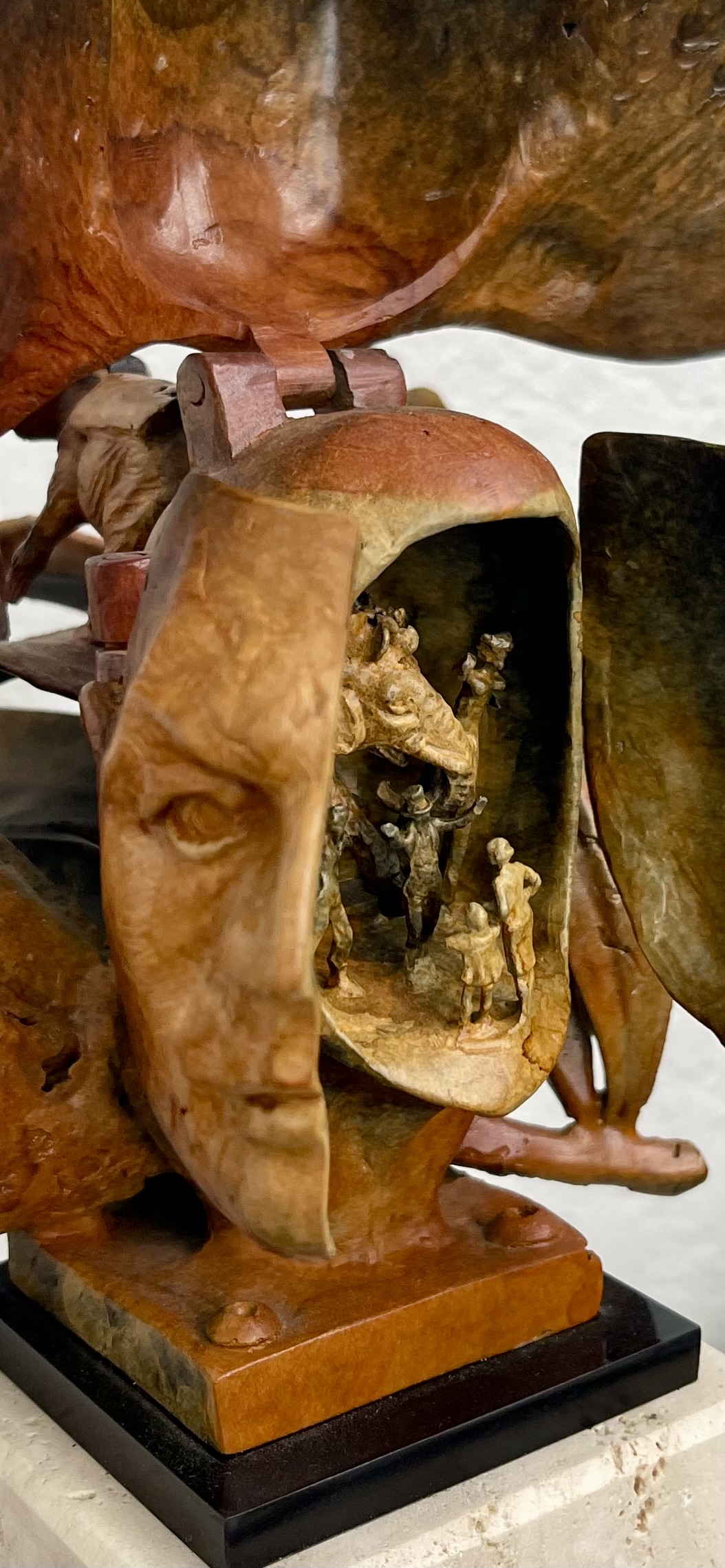
Collectors who encounter a Gall sculpture for the first time often pause before they truly see it. At a glance, his works appear like surreal monuments: hybrid creatures, mechanical faces, delicate humans climbing through symbolic architectures. But linger for a moment, and the sculptures begin to unfold — literally and figuratively. Hinged panels open to reveal miniature scenes, figures in motion, animals emerging from the subconscious of a face. Secret compartments transform into hidden worlds.
It feels less like viewing art and more like reading chapters from a myth that hasn’t been written yet.
For decades, T. Gall’s sculpture series has carried an almost cult-like fascination among collectors. And like any artist whose work is part sculpture, part storybook, and part dream-logic puzzle, a simple question emerges:
Where do these worlds come from?
An Artist Trained in Structure, Driven by Imagination
Before T. Gall became synonymous with bronze, he was a student of form. The son of a machinist, he grew up watching nuts, bolts, and gears move with purpose. Later, he trained in graphic design and industrial fabrication, disciplines that gave him a deep respect for mechanical exactness. Yet it was his exposure to early 20th-century surrealism — Ernst, Dalí, Tanguy — that opened the floodgates.
Gall saw sculpture as a bridge between reality and the unconscious. A place where mechanics could meet dreams, and where technical precision could coexist with mythology.
Why Collectors Are Drawn to Gall’s Sculptures
In an art market that often prizes minimalism or cool conceptualism, Gall’s unapologetic maximalist imagination stands out. His work rewards close looking. It asks you to step into a universe where symbols are fluid and where the boundary between myth and machinery doesn’t exist.
For many collectors, owning a T. Gall piece feels like adopting a fragment of a much larger mythos.
human vs. animal
machinery vs. flesh
interior vs. exterior
conscious vs. subconscious
Opening the Face: Discovering the Story Within
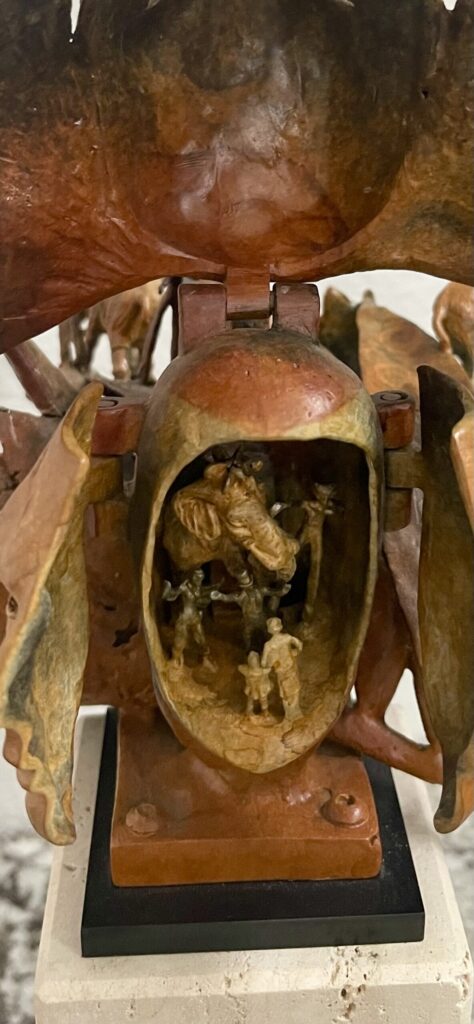
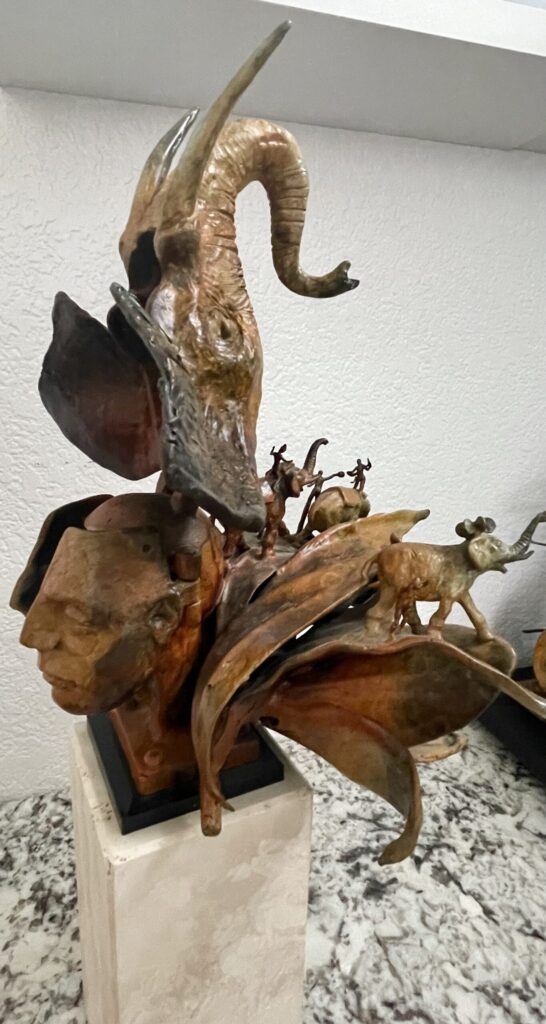
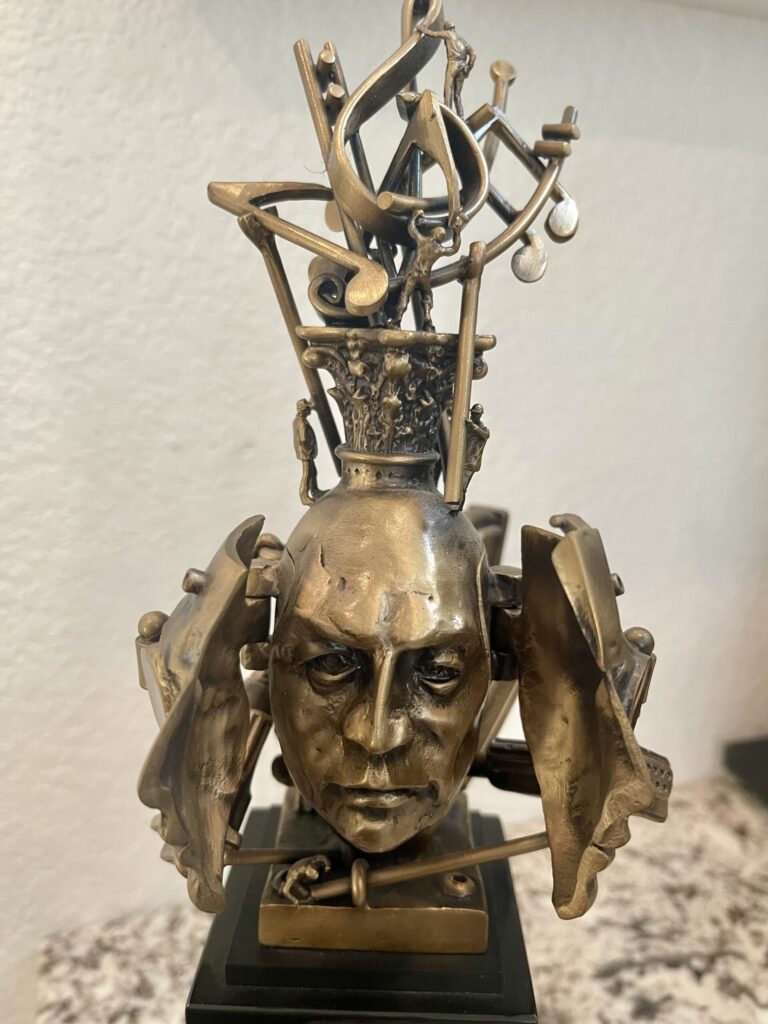
One of the recurring elements in T. Gall’s work is the segmented or hinged face — a motif that collectors immediately recognize. In the sculpture featured in our January 25th auction, the face is not simply a mask but a doorway. Two panels open outward like the pages of a book, revealing a hidden interior scene: tiny figures, an elephant, a microcosm carved in shadow and dimension.
This device — opening the face to reveal the psyche — tells us much about Gall’s philosophy. He once said in an interview:
“We all carry worlds inside us. Most of us never let anyone see them.”
Gall chose bronze not merely for its permanence but for its symbolic weight. Bronze endures. Bronze remembers. And for an artist obsessed with internal worlds, it became the perfect vessel.
In many of his pieces, the face represents identity, the animal forms represent instinct or spirit, and the internal dioramas represent memory, childhood, protection, or fear. His sculptures function like psychological portraits — surreal, personal, and universal.
The Elephant as Archetype
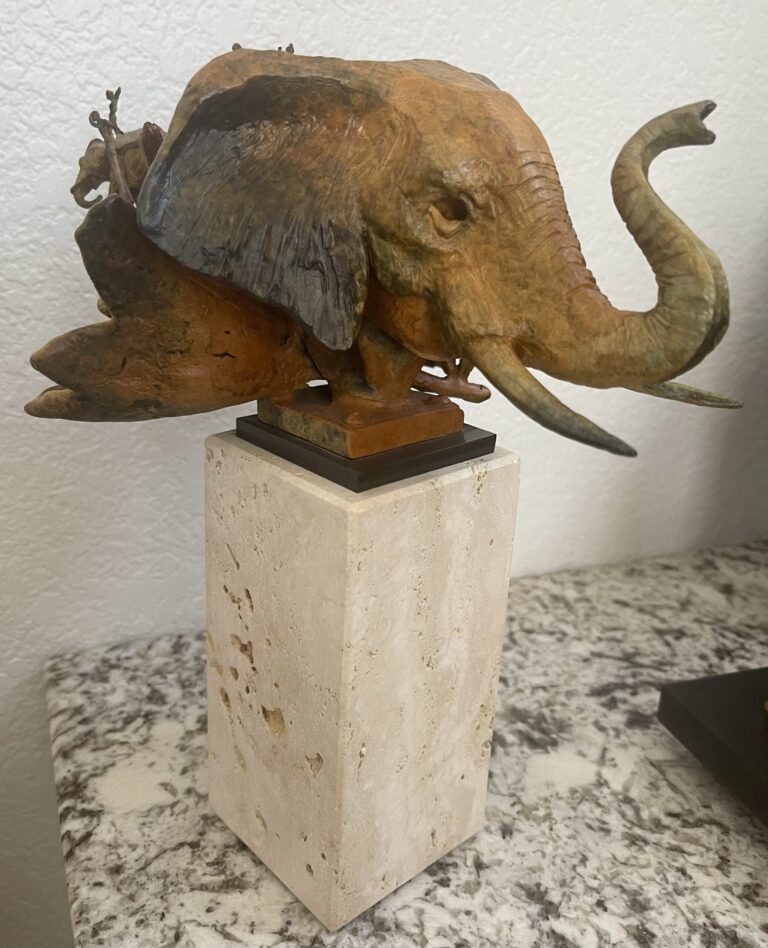
In Gall’s universe, animals are not decorative; they are symbolic stand-ins for mythic forces. The elephant, nearly always present in his more narrative works, carries associations of wisdom, loyalty, and ancestral memory. In the sculpture accompanied by a sweeping elephant head, Gall seems to merge the internal and external — the creature that carries history on its back stands guard as smaller figures inhabit the hidden chamber inside the face.
It’s not merely surreal for surrealism’s sake.
It is the kind of storytelling born from deep introspection.
Elephants appear throughout Gall’s oeuvre because they bridge the physical world and the mythological one. They are guardians, companions, and storytellers — much like the sculptures themselves.
Mechanical Symbolism and the Human Mind
While Gall’s work is always organic, there is mechanical logic to his construction. Hinges, joints, pins, and implied mechanisms are part of the aesthetic. They suggest that the human mind — with all its memories, instincts, and contradictions — is itself a kind of machine.
Not a cold machine.
A living, breathing one.
One that opens and closes, hides and reveals, protects and exposes.
Collectors have always noted how tactile his pieces feel. They invite touch (even if museum etiquette forbids it). They feel like artifacts from a lost civilization — functional, ceremonial, engineered for mystery.
Three Sculptures, Three Chapters of the Same Story
In the collection featured in our upcoming auction, three distinct T. Gall sculptures appear together, creating an accidental trilogy.
A remarkable work whose interior opens to reveal miniature figures — a symbolic narrative about memory, guardianship, and inner worlds.
A signature Gall motif: the human face as architecture. Hinges and plates create a mechanical mask, while expressive eyes anchor the sculpture in humanity.
A surreal explosion of musical notation, figures, and sculptural movement emerging from the crown of a divided face — a literal visualization of creativity breaking through the cerebral shell.