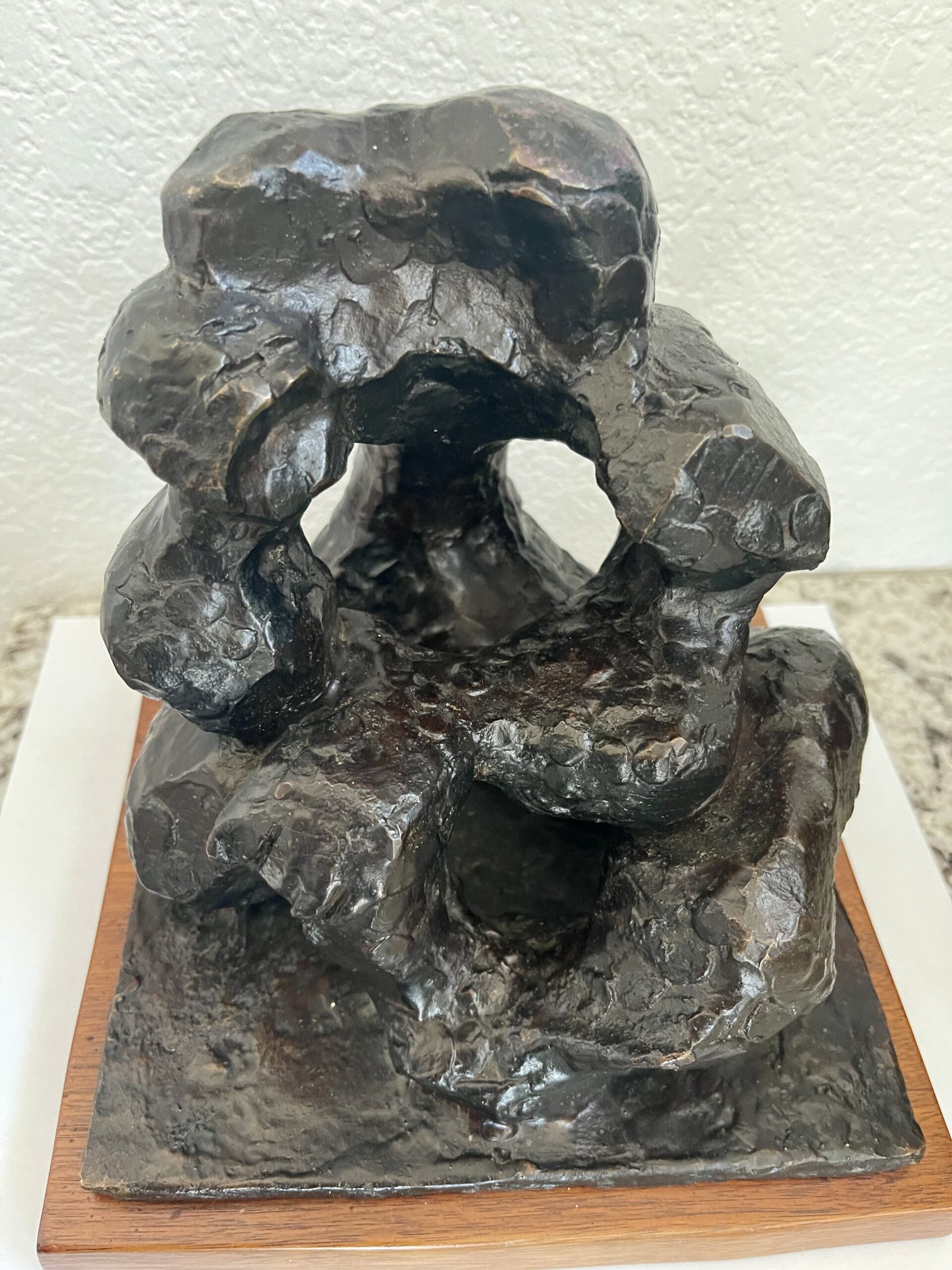
Jacques Lipchitz (1891–1973) “Meditation”, Grandview Art & Auctions

Jacques Lipchitz Meditation Bronze

1926

Jacques Lipchitz (1891–1973), one of the foremost sculptors of the twentieth century, played a defining role in translating the language of Cubism into three-dimensional form. By the mid-1920s, however, Lipchitz began moving toward a more lyrical, expressive sculptural style—an evolution beautifully captured in Meditation (1926), offered here as Cast 3 of 7.

Modeled in the years following World War I, Meditation portrays a seated figure slumped forward, one arm propping the head in a gesture of introspection and fatigue. The work balances weight and openness: solid, architectural masses are softened by rounded contours and carefully considered voids. This interplay between volume and negative space became central to Lipchitz’s later “transparent” sculptures, where structure and emotion merge into a unified visual language.

Though rooted in Cubist geometry, the sculpture reflects a clear shift toward human presence. Rather than fragmenting the figure into abstraction, Lipchitz distills a universal moment—quiet reflection, exhaustion, or inward thought—making Meditation both intimate and monumental in feeling.

Bronzes from this period are highly regarded, representing a turning point in Lipchitz’s artistic development. Works from the 1920s appear in major international collections, including the Metropolitan Museum of Art and the Museum of Modern Art, underscoring the enduring influence of this pivotal era in his career.

As a limited cast with exceptional provenance, Meditation (Cast 3/7) embodies Lipchitz’s transition from strict Cubist structure to a sculptural language imbued with emotion and depth. It stands not only as a significant modernist artwork, but as a testament to the evolving spirit of early twentieth-century sculpture—where innovation, humanity, and form converge.

  • Bronze
  • Bronze
  • 7.5" x 7.5" inches
  • Jacques Lipchitz

Add Your Comment

Grandview Auctions – © 2025-2026. All Rights Reserved
Privacy Policy / Terms of Use

Jacques Lipchitz Meditation Bronze, Grandview Art & Auctions

Jacques Lipchitz Meditation Bronze

Dive in to discover dramatic undersea landscapes and the extraordinary organisms that inhabit them. Find out how scientists are developing unique “stealth” technologies to make sure humans can observe here without disrupting.
Jacques Lipchitz (1891–1973) “Meditation”, Grandview Art & Auctions

Jacques Lipchitz (1891–1973), one of the foremost sculptors of the twentieth century, played a defining role in translating the language of Cubism into three-dimensional form. By the mid-1920s, however, Lipchitz began moving toward a more lyrical, expressive sculptural style—an evolution beautifully captured in Meditation (1926), offered here as Cast 3 of 7.

Modeled in the years following World War I, Meditation portrays a seated figure slumped forward, one arm propping the head in a gesture of introspection and fatigue. The work balances weight and openness: solid, architectural masses are softened by rounded contours and carefully considered voids. This interplay between volume and negative space became central to Lipchitz’s later “transparent” sculptures, where structure and emotion merge into a unified visual language.

Though rooted in Cubist geometry, the sculpture reflects a clear shift toward human presence. Rather than fragmenting the figure into abstraction, Lipchitz distills a universal moment—quiet reflection, exhaustion, or inward thought—making Meditation both intimate and monumental in feeling.

Bronzes from this period are highly regarded, representing a turning point in Lipchitz’s artistic development. Works from the 1920s appear in major international collections, including the Metropolitan Museum of Art and the Museum of Modern Art, underscoring the enduring influence of this pivotal era in his career.

As a limited cast with exceptional provenance, Meditation (Cast 3/7) embodies Lipchitz’s transition from strict Cubist structure to a sculptural language imbued with emotion and depth. It stands not only as a significant modernist artwork, but as a testament to the evolving spirit of early twentieth-century sculpture—where innovation, humanity, and form converge.

Share:

More Posts

Consign with Grandview